
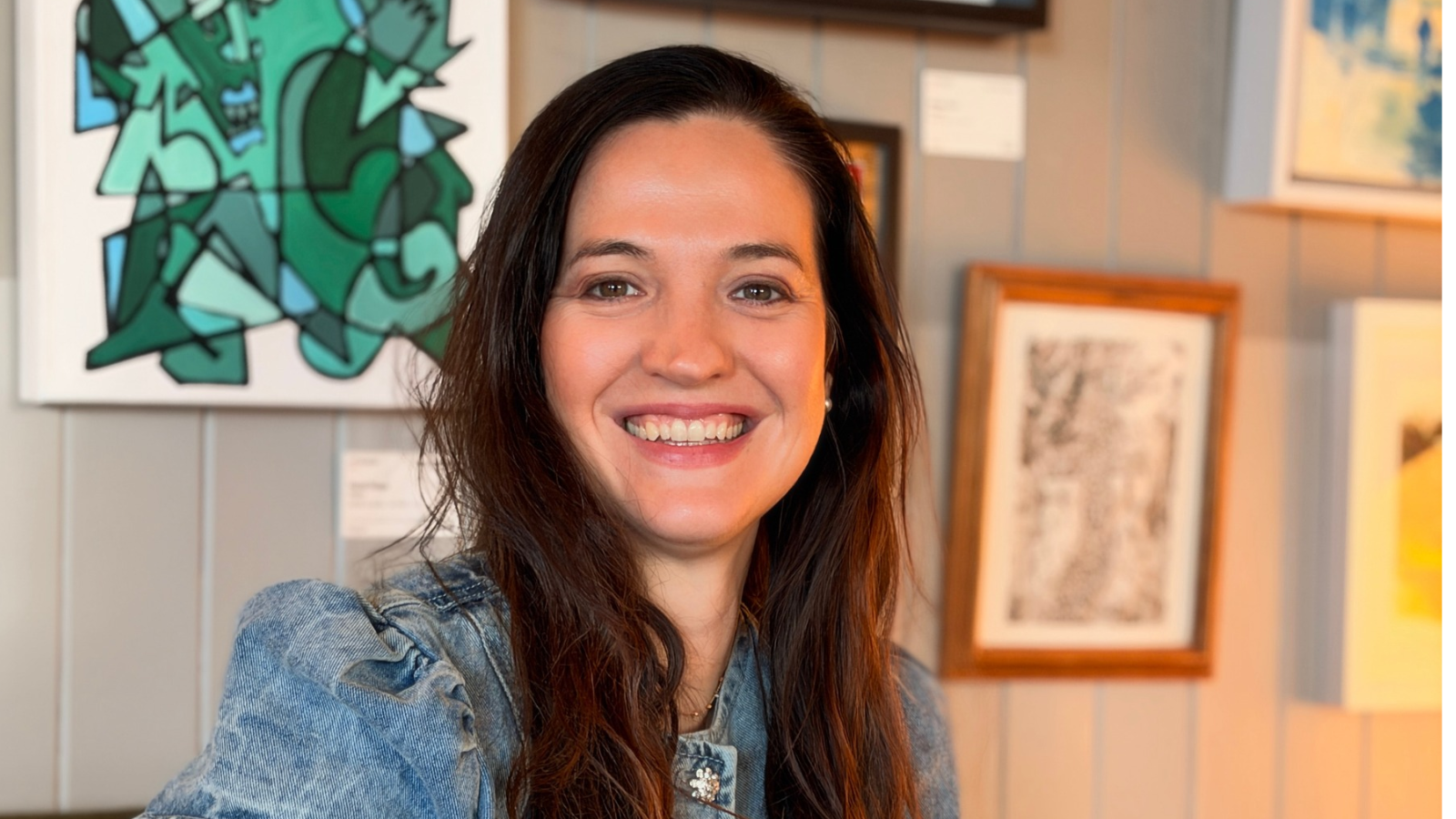
Jenny De Pretto experienced a deep personal loss which led to her having a change of direction in her life.
Having previously had a successful career working as a lawyer and in financial services, Jenny would go on to find comfort in creativity and yoga whilst coping with grief, an experience that inspired her to help others.
Jenny brings those same practices into the workplace environment through Jenny Art & Yoga, her Greenwich-based wellbeing company.
In her role, she delivers creative workshops with yoga and relaxation sessions, Jenny helps people take a break from busy and fast-paced working lives and build meaningful connections with their colleagues.
Jenny reflected on what has shaped her approach, why creativity deserves a place in workplace wellbeing and how small, regular moments of connection can make a difference.
In this week’s feature of Wellnergy’s Voices, Jenny told her story about how she wants to share her life experiences and help others.
- What first made you realise how much people were missing genuine connection and embodied wellbeing at work and how did that moment shape your decision to leave law and found Jenny Art & Yoga?
I spent a long time in corporate life. I’m a qualified lawyer and I worked in financial services in compliance and financial crime prevention.
For years, I thought that was what I wanted for myself. But deep down, the job wasn’t really fulfilling. I’m a people person and I wanted to do something that could have a real impact on people.
What really made me realise this was a life event. I lost someone very close to me.
During that time, I turned to art, creativity and yoga. They helped me so much to cope with stress and grief. That opened my eyes. I started to think that maybe I didn’t want to spend my whole life in the corporate world.
So, I decided to found Jenny Art & Yoga to bring creativity and yoga back into the workplace to help people and build human connection.
Research shows that just 45 minutes of creative activity can help reduce cortisol, the stress hormone, and I see it in every session I run.
- Which one or two pieces of research influenced you on how you would design these experiences?
The research that inspires me most is the work of Professor Daisy Fancourt. She’s a Professor of Psychobiology and Epidemiology at UCL and Director of the WHO Collaborating Centre on Arts and Health and her book, Art Cure, brings together years of research on how the arts affect our health. I really admire her.
Her main idea is that the arts are the ‘fifth pillar of health’, together with diet, sleep, exercise and nature.
Art isn’t a luxury or a nice extra, it’s something we need.
Her research shows that regular arts engagement can nearly halve the risk of developing depression over ten years and that for people who already have depression, adding the arts to their treatment can double the improvement.
She also explains that this isn’t just a feel-good effect. Creativity changes what happens in our bodies and brains and it lowers stress, lifts our mood and helps us process difficult emotions.
This is exactly what I try to bring into every experience I design so that people don’t just come for an hour of painting, they come away with a simple tool they can use to cope with stress and with life.
3. What’s the most important benefit of creative, embodied team experiences that you wish more leaders understood?
For me, the most important thing is the connection. The human connection.
People often arrive quiet and a bit unsure. Then they start painting and they relax enough to just be themselves.
The activity gives everyone something to focus on that isn’t each other, and that’s exactly when people open up. They start having conversations they would never normally have at work.
This is what I wish more leaders understood. Those conversations build trust and that is what makes a team work well together long after the session ends.
A lot of wellbeing at work today is based on apps. They have their place but where is the human connection?
We spend all day looking at a screen and then for our wellbeing, we’re asked to look at another screen.
What people really need is to put the screen down, sit together and make something with their hands.
4. What does a realistic, sustainable wellbeing starter plan look like over four to eight weeks?
I always say, keep it simple and keep it regular. One big wellbeing day is lovely but it’s the small moments, repeated every week, that really make a difference.
Over six to eight weeks, I would suggest something like this:
Week 1: Start with a creative experience together, like a Mindful Mandala Making session. It breaks the ice, brings people together and shows them how it feels to slow down.
Weeks 2 to 4: A short weekly session of around 30 minutes, like chair yoga or guided relaxation. Nobody needs to change clothes or leave their desk and people can join in person or online.
Week 5: A second creative experience. For example, painting a plant pot or a notebook. People take it back to their desk and it becomes a little daily reminder to pause.
Weeks 6 and 7: Carry on with the short weekly sessions, maybe adding a yoga nidra session for deep rest.
Week 8: Close with an experience that brings creativity and gentle movement together and take a few minutes to reflect as a team: what did you notice, and what do you want to keep?
And I always ask the team what they enjoy, because when people feel part of it, they keep coming back.
5. What are the most common misconceptions or barriers?
The biggest one I hear is ‘we don’t have time’. The second is ‘my team isn’t creative’ or ‘it’s just arts and crafts’.
What I always explain is that creative activity is not the goal, it’s the way in.
Nobody needs to be an artist and nobody is judged on what they make. Honestly, an hour together like this often gives people more energy for the rest of the day, not less.
Some organisations also worry that people won’t join in. But what I see repeatedly is that the most sceptical person in the room is often the one who enjoys it the most by the end.
Of course, the organisation plays a big part too. When they arrange something like this, they need to really invite people, encourage them to take part and make them feel comfortable doing it.
The message should be ‘This time is for you. We organised this for you, so please come and join in.’
6. How do you help participants notice and interpret the shifts that come from these sessions?
It depends on the session. In my yoga and relaxation classes, I make people aware of it quite directly. I invite them to pause and notice how they feel in their body and in their mind, at the start and again at the end.
In the introduction to my creative experiences, I usually say that most people arrive feeling a bit stressed and that by the end of the session they will probably feel much more relaxed. Then I just leave it there and let them experience it for themselves.
I think that’s much more powerful than me telling them how they should feel.
7. If you had to describe your approach in a sentence or two, what would it be and why?
I create calm, inclusive spaces where people can slow down, reconnect with themselves and with each other and leave feeling lighter.
Everyone is welcome, whatever their experience because I believe wellbeing should never feel intimidating or exclusive.
8. Can you share a specific example of a team or individual whose wellbeing noticeably improved?
One experience that really stayed with me was a session I ran for Lesbian Visibility Week, for TfL’s Women’s Colleague Network Group and OUTbound.
The people taking part didn’t know each other at all. They worked in different teams, in different TfL buildings across London.
They joined me for an afternoon that started with a yoga class. People really relaxed, tuned in and took some time for themselves.
Then, because our venue was right by the river, we went for a walk along the water. The first part was a mindful walk in silence, where people simply noticed their surroundings, their breath and their steps.
Then I invited them to walk and chat with each other and that’s where people really started to open up.
When we came back, we moved into a creative activity. At first, everyone was concentrating on their paintings. But after a little while, the conversation started to flow.
Sometimes, all I needed to do was ask one simple question and people started talking to each other and sharing little bits of their lives.
For me, it was a real example of human connection, and I like to think some of them stayed in touch afterwards.
Beverly Rust, Senior Engineering Leader and Chair of TfL’s Women’s Colleague Network Group, later shared this feedback
“Jenny tailored the event perfectly to our requirements, combining yoga and mandala painting to create a wonderful mix of wellbeing and creativity. Participants thoroughly enjoyed the experience, and the event was a huge success. I would highly recommend Jenny to anyone looking for someone who can create engaging, inclusive and meaningful wellbeing experiences.”
9. For busy teams who feel they don’t have time, what are your go-to strategies?
My answer is always start small. Wellbeing doesn’t mean a full afternoon away from work. Even a short session can make a real difference.
For busy teams, I often suggest something like a 30-minute chair yoga or relaxation session or a short creative break over lunch.
Then, little by little, you can build on it. Once people feel the benefit, they usually want more, and that’s the moment to try a longer creative experience together.
10. Where do you see the conversation around workplace wellbeing, connection and creativity heading?
I really believe we are at a turning point. The more our work becomes digital, remote and shaped by AI, the more we will need things that are human and real making something with our hands, sitting in a room with colleagues and talking. I think these moments will become more valuable.
I also think creativity is starting to be taken more seriously. The research grows every year and in healthcare, the arts are already part of how people are supported.
I hope workplaces will follow, so that a creative session becomes a normal part of how people stay well and work well together.
I would love Jenny Art & Yoga to be part of that change.
11. What are your overall thoughts on Wellnergy, and how did you become aware of the company?
A friend told me about Wellnergy and we were meant to go together but in the end she couldn’t make it.
So, I went on my own and honestly, I loved it. I didn’t feel alone for one minute.
The festival was so well organised and the organisers were really kind. It felt like a big family.
Being a yoga teacher, I spent a lot of time in the yoga tent. There were lots of sessions with different teachers and the energy in there was just beautiful.
Everyone made you feel welcome, even if you had never done yoga before.
I also loved the talks and d it was nice to chat with the vendors and discover new brands I didn’t know.
What I liked most is that it really was a festival for everyone. Whether you love yoga, Pilates or weightlifting, there was something for you. It was fun and I went home feeling good.
Find out more about Jenny Art & Yoga here: Jenny Art & Yoga | Corporate Wellbeing & Creative Workshops
Learn more about Wellnergy here: WELLNERGY London Festival | Energising Life